Breathing Together, Dreaming Forward: Transmissions from Life- Affirming Visions of Tech — Retreat No. 1
by Esra Özkan and Ari Robey-Lawrence
Imagine what you can cultivate with the people around you. Imagine that they are relying on you, and you are relying on them.
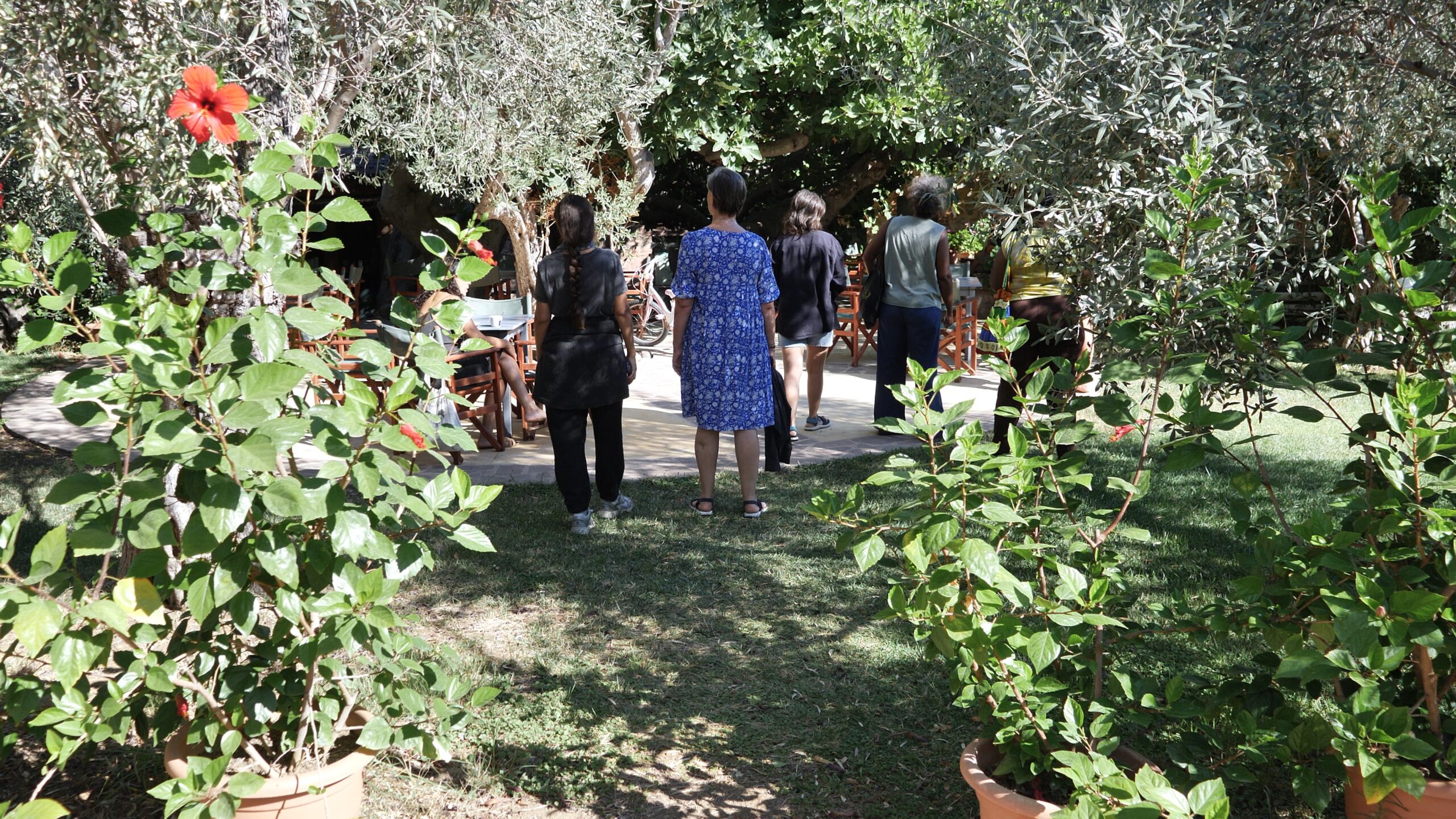
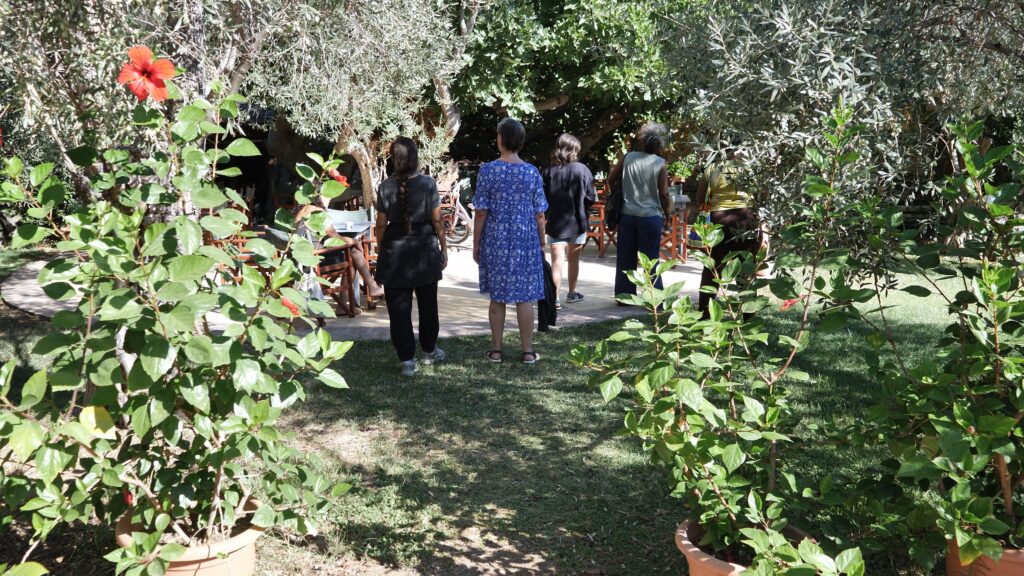
Those words from the opening breathwork exercise, borrowed from adrienne maree brown, permeated our first circle, carried on the warm, ocean air of Lesvos — salt-tinged, threaded with the distant hush of waves, sweetened by lemon, fig, olive, and pomegranate trees overhead.
In this spacious atmosphere, over three days in late summer 2025, twenty police monitoring and anti-repression organisers, technologists, digital rights advocates and social justice activists gathered to map visions for collective safety and liberation – and to collectively shape a peer learning and practice programme that supports and equips organisers to operationalise those visions in their work.
Continuing the work on Digital Policing
The project ‘Life-Affirming Visions of Tech’ is a continuation of Weaving Liberation’s series of convenings that brought together racial, social, digital and economic justice organisations from all over Europe to support and strategise around anti-racist, feminist visions, while confronting the harms imposed by digital policing. In those convenings, organisers and advocates identified one key goal: building capacity to create infrastructures of care and support while working towards dismantling technologies of control.
What are the ways in which we can redirect resources away from punitive practices, institutions and tools towards building community health, safety and well-being?
This project is not only an attempt to seek answers to that question but also to explore ways of concretely operationalising those visions and make sense of the role of technology within them. Framed as a Knowledge and Imagining retreat, it was specifically meant to make collective decisions as to how to spend a pot of money based on the needs identified by the participants to build capacity to realise those visions.
Grounding ourselves in the futures we want
We anchored our work in the abolitionist tradition that understands “life-affirmation” as a demand, not a metaphor. Ruth Wilson Gilmore reminds us that “abolition is about presence, not absence. It is about building life-affirming institutions.” We ground ourselves in the work of abolitionist organisers around the world and ask:
What does it look like to situate technology in a world without police, prisons and borders? What would life-affirming tools, infrastructures and practices in a liberated future look like?
The context we organise in is increasingly challenging due to the criminalisation of marginalised communities on the one hand, and the dangerous settling of authoritarian, fascist forces and politics repressing social justice movements, on the other. The dynamics of criminalisation are amplified by the deployment of digital tools increasingly being used to surveil, control, sanction, and deter any kind of act of solidarity and dissent. From identification tools such as biometric technologies to databases that track and trap millions of lives, from movement surveillance tools such as smart cameras and drones, to communication tracking tech such as phone extraction and social media monitoring, we have to see the forest for the trees: the perpetuation of historical injustices. This architecture of surveillance disproportionately criminalises and sanctions racialised communities, impoverished, disabled, queer, migrant and gender-minoritised communities.
Moreover, digital technologies create a particular paralysis effect, appearing too colossal, opaque and pervasive to confront — which makes cross-movement exchange and strategising even more necessary. There have been invaluable initiatives to dissect police tech harms, generate insights, and share strategies of action from a social justice perspective in various movement spaces. Building on those experiences, what we need most is articulating and deepening shared visions and aligning our focus with what we are fighting for.
From the start, the retreat was an invitation for the participants to begin sharing reflections on their understanding of life-affirming visions. Nish Doshi, a retreat participant with expertise in tech and disability justice, described the concept as deeply imaginative:
…To me it’s like dreaming—it’s linked to the concept of dreaming, in the sense that it’s a world that we could be part of; a world that’s different, a world that centres what we actually need.
Life-affirming visions are abolitionist visions. They are about the world we want to live in and the society we want to build — without police, prisons, and other forms of carceral structures.
During the first day, we supported those visions to come alive through a ‘Future Screenshots’ exercise, designed by Mushon Zer-Aviv. The activity was a collective act of future archaeology during which we sketched snapshots from our future lives in care-based, justice-driven societies. Working with entry points like healthcare, housing, employment, justice, and community autonomy, the exercise invited us to imagine beyond the logic of surveillance and punishment. Using mobile phone-shaped templates, participants created artifacts from possible futures: social media posts announcing community victories leading to reparations, chat conversations about new forms of mutual aid or infrastructures of collective accountability, notifications from land cooperatives, and maps of liberated territories.
From local realities to abolitionist horizons
We were privileged to co-organise this gathering with comrades from Greece. As a Europe-wide project, wherever we go, it’s important for us to first ground ourselves in local realities and learn from local initiatives, recognising that any liberatory endeavours are anchored. With Lesvos being an outpost of the European border regime as well as border technologies, it felt right to start by making sense of the local realities first. We connected with organisers during a panel discussion joined by WISH (Women in Solidarity House), Legal Centre Lesvos, Copwatch GR, and Aegean Migrant Solidarity. These presentations set the foundation for reflection on the many forms collective care can take, even under the weight of brutal border and policing regimes.
Their histories of creating infrastructures for migrants, and resisting border violence, have evolved from self-organised groups meeting urgent needs, into networks that inspire wider solidarity on the island. Importantly, for some groups, there has been a transition from helping individual cases to working more on tracing and exposing the political economy behind border tech and pushbacks.
We ended our day with an exercise of analysis, which required us to hold up a mirror to our ecosystem and ask ourselves, what needs to change in our work to move towards abolitionist horizons. Through this work, we were able to surface some of the contradictions we need to navigate. One of the tensions addressed was working within the framework of securitisation, which is a process where social issues are identified as security threats. Undergirded by the notions of ‘state of emergency’ and ‘state of exception’, these narratives are used to justify pouring more power and money towards the police and tech companies as a solution to massive social problems. As organisers, the same logic pushes us into a reactive state in opposition to the constant flow of new laws, technologies and discourses that criminalise, surveil, and target racialised and other marginalised communities. That state of being is one of survival and triggers emergency responses from our side, which are at times in contradiction with our long-term strategies. To disrupt harmful systems and build the ones that we want, we need to move ourselves outside of an emergency mindset and identify the root causes of the issues.
When shifting power is our direction, we can align our daily work accordingly. Whether it is pushing for redistribution of resources and reparations towards historically marginalised communities or building institutions outside the current status quo modelling our principles, or making public money available for building technologies that support well-being free from exploitation and violence; all the roles we play in the movement ecosystem matter.
Building life-affirming practices
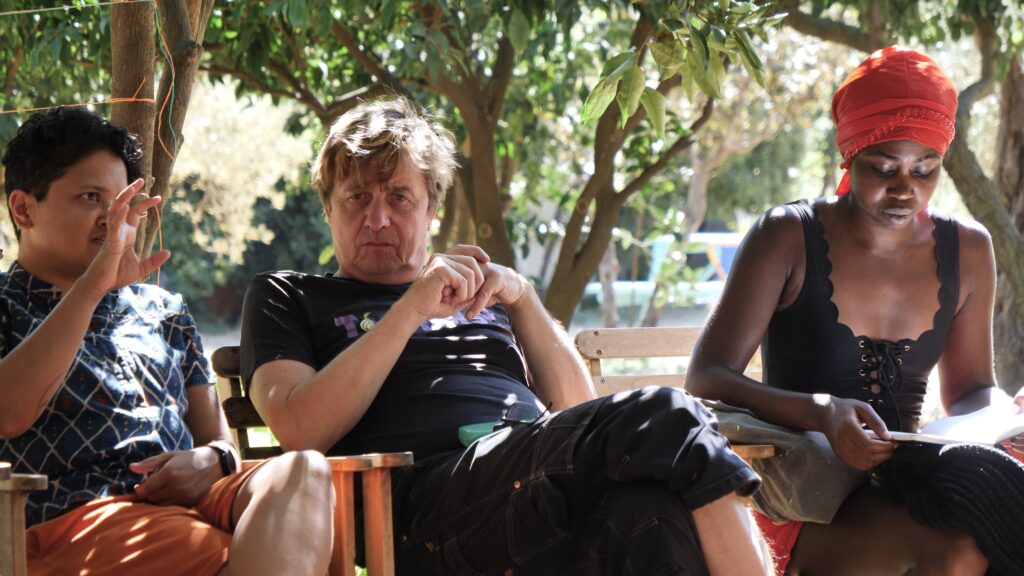
With the sea’s steady rhythm in our ears and ripe branches overhead, we leaned into mutuality, ready to translate those opening breaths into deeper conversations about police tech and building resistance to move beyond reform towards liberation. Day two brought dynamic exchanges: a World Café surfaced practical examples of already existing infrastructures of care within movement spaces.
In abolitionist gatherings, we tend to focus more on the future and what needs to be done towards that, and often overlook what is already being built here and now — what are the seeds of the futures we want in the presents we inhabit?
We learned from Zara Manoehoetoe about the care-based practices of Kids of Colour and Northern Police Monitoring Project that reminded us how important it is to turn good intentions into well-functioning infrastructures, processes, and practices of care in our organisations. Nish Doshi shared their experiences of creating spaces for disabled people to meet, connect, heal, learn and to build the future they dream of in the present with the Sustainable Disabled Futures gatherings. Multidisciplinary artist, interaction designer, and programmer Iyo Bisseck also led us through a conversation on how to build situated technologies based on their experiences of collection, preservation, and sharing of archives.
We devoted an entire afternoon to Open Space sessions, with the intention of creating a generative slot in which the cohort could set the agenda and take time for what matters most for them and their organisations at that moment. Participants self-organised and documented six sessions in two rounds revolving around a series of questions:
How can we formulate abolitionist demands?
What are the ways in which ordinary people resist tech?
How can information gathering serve abolitionist strategies?
How can we build political discourse around abolition?
What are the examples of organising solidarity with incarcerated people?
The magic of Open Space sessions took hold; by the end of the day, after gathering and recording all of the notes, we knew what the group wanted to do next, collectively. Almost all the different Open Space sessions came up with action proposals which, in turn, shaped our planning on the final day.
From imagining to building together – deciding collectively on a programme
On the last morning, we distilled reflections and proposals from the previous day into a brief passage which we called the ‘Open Space Manifesto’ which then evolved into our peer-learning and practice programme. This programme gathers the group’s priorities and mid-term next steps into one shared frame, rooted in the retreat’s reflections, proposals, and collective planning. Rather than a static document, it is a shared compass — pointing towards a living network committed to co-creating more liberatory futures for all. It stands as our first waypoint, marking the shift from collective imagining to the tangible work we have pledged to take on together. Each working group took away concrete tasks and timelines, but also an invitation to stay porous: to keep refining these priorities as conditions shift and new collaborators join.
In the wake of those three days, what remains is a set of clear commitments, new and evolving collaborations, an expanded sense of possibility, and the recognition that when we organise across difference, even our most ambitious visions can begin to take root.
Carrying this momentum forward, we will refine the programme and allocate the project budget to working groups in consultation with all the participants who will steward specific aspects. In essence, the programme will help us to continue exploring life-affirming visions, start testing some of them, and create the conditions for others to do the same. Most importantly, we will keep the space of connection ongoing to allow us to touch base, bounce ideas off of each other, share learnings, raise questions, and celebrate as different parts of our programme come to fruition.
Pictures and film by Alice Z. Jones