
March 2026 Deep Dive: Resisting Digital Policing
Across Europe, organisers and communities are shaping what digital justice looks like in practice: organising for alternatives, dismantling harmful infrastructures enabled and amplified by the tech industrial complex, and nurturing liberatory futures into being. Each month, we gather resources, spotlight work happening across the ecosystem, and share insights from our programming around topics that shape the moment. This series is a space to move beyond critique—to delve into resistance in practice, celebrate visions already taking root, and imagine what we can grow together. This month we're exploring Resisting Digital Policing.

Dive in, get curious and imagine with us!
Sunday, March 15 marked the annual International Day Against Police Brutality. When talking about policing, we have to talk about surveillance, control and sanction. For women, trans and cis, queer, and gender-diverse communities, every day is a fight against the Big Lie of surveillance that wears the mask of “safety”.
Digital policing doesn’t keep us safe—it marks, classifies and categorises us. It fuels oppressive systems and put marginalised communities in harm’s way. It uses our online activities, our presence in the street, when applying for visas, welfare, crossing borders etc. to monitor and restrict us.
Resisting digital policing means centering marginalised communities’ needs in anything relating to policing. It means defunding the police as we know it today, and create instead ‘agents of care’ who work hand in hand with communities they have historically been harming.
– Oyidia Oji, European Network Against Racism (2023)
This month, we’re turning toward each other—and toward what’s possible.
Resist with us. Gendered surveillance thrives in isolation. If you’re organising, experimenting, or finding ways to push back, we want to hear from you!
Imagine with us. In March, we uplifted organisers, artists, and researchers who aren’t just fighting the digital dragnet—they’re building pathways around it. Their work shows us what else is possible.

In January, Statewatch published news detailing the EU’s disturbing plans to expand cross-border travel surveillance. Currently, police collect data on all plane journeys into and between EU countries. New proposals would extend this to sea, rail, and road travel—and allow the data to be used for immigration enforcement, potentially bypassing existing EU Court safeguards. A working group including the Council, EU state authorities, and the European Commission has been meeting to discuss next steps.
Who’s tracking this? Who’s pushing back? Statewatch continues to monitor and expose these moves. Keep up with their work on social media at @statewatcheu.
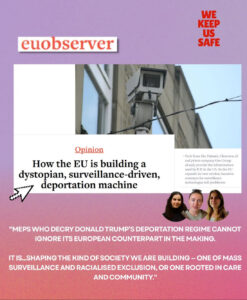
Earlier this month, We Keep Us Safe shared an important op-ed piece in EU Observer exposing the tech powering Europe’s emerging deportation and surveillance machine.
They’re also on the ground fighting it— keep up with them on social media at @wekeep_ussafe and @eu_observer to learn more about the fight against deportation and raids in Europe.

Access Now’s new piece + database exposes the private sector’s hidden role in building borders—from biometrics to drones. The “war on migrants” has a corporate face. Caterina Rodelli’s article takes us further into the many faces of the Hydra of mass surveillance at borders in the EU. This investigation names names— and calls for accountability.
Follow @accessnow’s work to track who’s building borders, and who’s pushing back.
What can we learn from how communities map and challenge police surveillance?
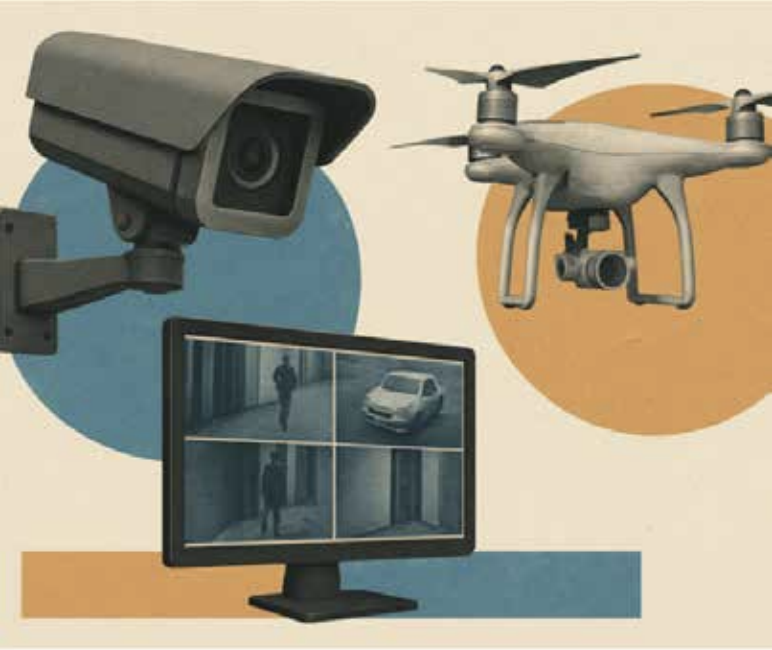
Last year, Comunidad Negra Africana y Afrodescendiente en España (@cnaae_ ) produced a groundbreaking report mapping police surveillance technologies in Catalunya. Created with the Black Data Excavators project and JET (Justice Equity + Technology Project), the report documents the tools in use—from dataveillance to predictive policing—and offers a starting point for communities to continue the work of resistance and visioning.
Take a second look at our Digital Policing Toolkit, which went live last year.
What tools or strategies land differently, or stand out to you now? What’s changed—or stayed the same—over the last year? What new strategies are you trying— or dreaming up?

Cross-movement action and solidarity is foundational to our resistance efforts — Equinox’ International Women’s Day post sheds light on the intersection between gender justice and border violence, naming how migrant women face increasingly repressive conditions, including systemic and sexual violence at the hands of deportation regimes.
Find out more about their initiatives on social media (@equinoxrji).
What happens when online violence becomes a tool of offline repression?

New research from APC Network (@apc_network) examines how WHRDs in Brazil, India, Uganda and beyond resist, adapt and reclaim space in the face of digital authoritarianism—from surveillance to doxxing to legal attacks. Their strategies, rooted in global majority contexts, hold wisdom for us all. A necessary read on transnational solidarity and what holistic protection looks like when we learn across borders.
Get the full story.
Are you working on policymaking around technology?
Glitch UK’s (@glitchuk) recent post on creating non-reformist tech reforms sets a stage for fresh thinking in 2026.
Anchored in Critical Resistance’s(@criticalresistance) definition of abolitionist reform—reforms that shrink systems rather than expand them—they ask: how can we apply this framework to technology?What would it mean to advocate for tech reforms that don’t just make surveillance more “ethical,” but actually reduce its reach and power?
How do we apply abolitionist principles to the concrete reality of data-driven policing in our cities?
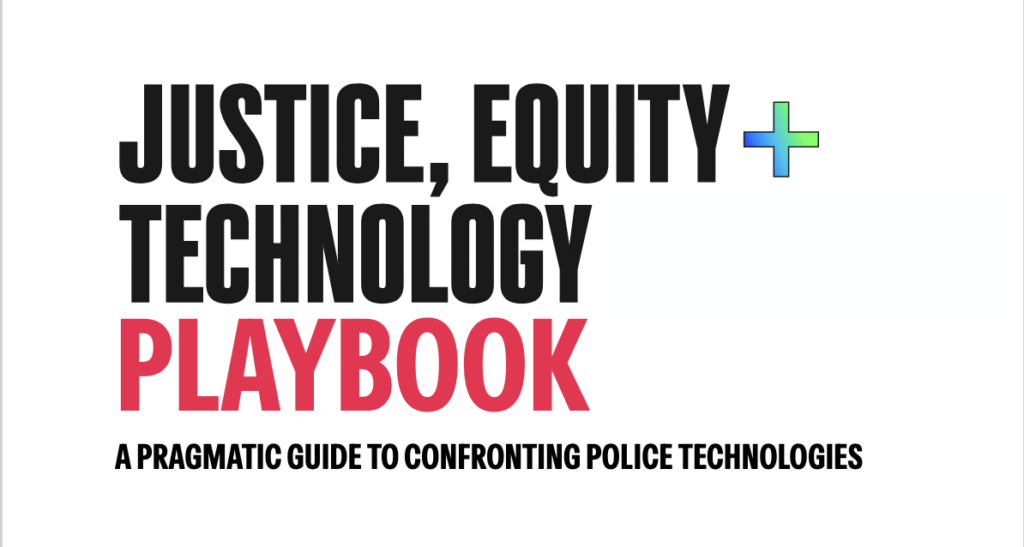
Justice Equity + Technology Project’s (JET) playbook provides a practical roadmap. Built from hundreds of events and collaborations, this rich resource shares facilitation tools to collectively confront police tech and its impact on racialised communities at a local level.

Revisit the conversation around resisting digital policing from 2025 with our co-founder Laurence Meyer, KOP Berlin (@kopberlin), and Zara Manoehoetoe of the Northern Police Monitoring Project (@npolicemonitor) and Kids of Colour UK (@kidsofcolourhq). Big thanks to Refuge Worldwide (@refugeworldwide) for hosting us!
Dreaming Beyond AI (@dreamingbeyondai) continue to help us imagine and advance visions of liberatory futures.
Their new exhibition ‘Portals Behind the Algorithm’ invites us to explore how do we reclaim both time and relation from the algorithmic forces shaping our world?
Opening on April 24 at @ifa.de gallery in Stuttgart, it brings together artists imagining futures beyond AI—through sound, video, VR, and archival work—the exhibition poses a question: how can art open portals to alternative temporalities and coalitional worlds beyond AI, and imagine futures otherwise?